Angelic Rodgers Personal Site
  • Angelic Rodgers
  • Privacy

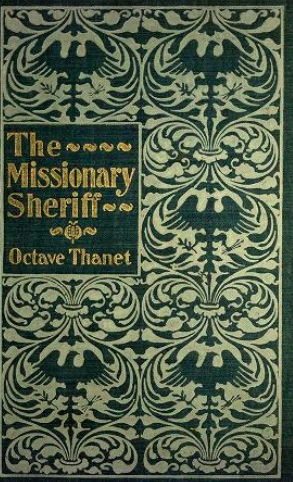
The Missionary Sheriff

2/21/2022

0 Comments

 
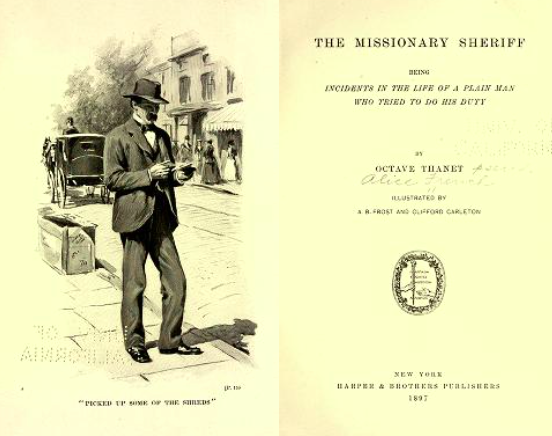
  • The Missionary Sheriff: Being Incidents in the Life of a Plain Man Who Tried to do His Duty. New York: Harper & Bros, 1897.
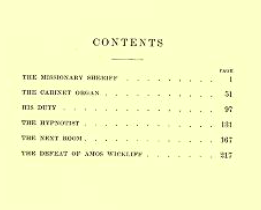
  • "The Missionary Sheriff." Harper's Monthly, XCII (April 1896): 773-87. Reprinted in The Missionary Sheriff: Library of the World's Best Literature, Ancient and Modern, ed. Charles Dudley Warner (New York, 1902), XXXVII.
  • "The Cabinet Organ." Harper's Monthly, XCIII (July 1896), 238-51.
  • "His Duty." Harper's Monthly, XCIII (September 1896), 612-21. Reprinted in both The Missionary Sheriff and in The Captured Dream​.
  • "The Hypnotist."  Harper's Monthly, XCIII (October 1896), 678-89.
  • "The Next Room." Harper's Monthly, XCIII (November 1896), 914-59.
  • "The Defeat of Amos Wickliffe." Harper's Monthly, XCIII (December 1896), 86-94.
In 1895, Alice's investments paid high dividends and her writing earned her more than $3,600. Henry Mills Alden had bought a short story, "The Missionary Sheriff," for $620, the most she had ever received for a story, and it was her first to be published in Harper's Magazine. Shortly after it was accepted, Harper and Brothers sent a letter asking that she write a series of short stories to be published first in Harper's Magazine and then to be issued by the publishing house in a single volume in 1897.  --McMichael, p. 145. 
McMichael's comments are primarily about the sale of the stories and how they mark Thanet's rising success. Rightfully so--the stories are amusing and heart-warming, but there's not a lot of substance here. In fact, themes of absent mothers whose pictures are hidden in bibles repeat, and the focus of the six-story cycle is primarily on Amos Wickliff, who "Alice had tried to show a western character's life and attitudes, and into her hero, Sheriff Amos Wickliff, she put all the masculine virtues she could muster for a rough man" (McMichael, p. 150).

Items of note:
  • Missionary: The title story is one where Amos befriends a dying prisoner at his jail when he discovers the man's mother's picture. Amos is an orphan with a clear allegiance to his parents, both of whom appear in his quarters in expensive portraits. He often talks to those portraits and seeks their counsel.  Perhaps this is why he's sympathetic to old Margaret Clark Cary in "The Next Room"--he has his own ghostly family. At any rate, after Ned/Edgar pleads his mother should never know his criminal identity, Amos sets out to make the man better, showing him how to truly honor his mother. The cycle of the story ends, of course, with Amos reaping the reward of marrying Ned's old fiancee Ruth in "The Defeat of Amos Wickliff."
  • Spiritualism: Two stories, "The Hypnotist" and "The Next Room" focus on the spiritualist movement popular in the late 19th century. In one, a woman is manipulated by a con man into giving him money and marrying him. Amos Wickliff happens to be visiting the town and sees the hypnotist's picture and realizes he's got a bounty on his head, so he intervenes.  In "The Next Room" the loan shark in town, known as "Old Twenty Percent" turns out to be a sweet older lady who sees her dead relatives. She's been having little seances at home and Wickliff sees no harm in her little rituals. When she "disappears" it turns out she was merely worried that her nephew Allerton, came looking for her to return her to the asylum. The story has a happy ending with Allerton agreeing not to harass his aunt.
  • Immigrant portrayals: There are multiple attempts at Irish and German accents. The portrayal of German and Irish immigrants doesn't seem awful, even if it is the stereotype of the Irish charwoman and German magistrate. The racism that is here is reserved for Italians and native Americans as whisky-loving savages.
  • There is one Arkansas woman--she's the wife of a fugitive photographer that Amos helps in a skirmish with native Americans. 
  • My highlights and brief notes.
0 Comments

Your comment will be posted after it is approved.


Leave a Reply.

    About this project:

    I've been saying since 2004 that I was going to write a critical biography of Octave Thanet (Alice French). This blog is the start of that work and will include notes, links to research, and other OT related tidbits.

    Archives

    February 2023
    February 2022
    August 2021
    July 2021
    June 2021
    April 2021
    March 2021
    February 2021

    Categories

    All
    1878
    1879
    1880
    1884
    1885
    1887
    1888
    1889
    1890
    1891
    1893
    1896
    1897
    1898
    Abandoned Child
    A Book Of True Lovers
    Arkansas
    A Slave To Duty
    Aunt Callie
    Caldonia
    Catholicism
    Century Magazine
    Chicago Railroad Strike 1877
    Civil War
    Clover Bend
    Conjure
    Convict Camps
    Cotton Pickers
    Dialect
    Digital Texts
    Domestic Violence
    Economics
    Essays
    Expiation
    Francis Plantation
    Highlights & Notes
    Hot Springs
    Howells
    Image Of The South
    Immigrants & Naturalization
    Knitters In The Sun
    Lost Texts
    Lum Shinault
    Mary Wilkins Freeman
    Native American
    Novels
    Otto The Knight & Other Trans Mississippi Stories
    Photography
    Politics
    Poor
    Race
    Racial Stereotypes
    Racism
    Racist Language
    Racist Sterotypes
    Railroad
    Realism
    Research Tools
    Scribner's
    Scudder
    Seminole
    Southern Myth
    Stories Of A Western Twon
    Strike At Glasscock's
    Suffrage
    Tenant Farming
    Tenements
    Thanford
    The Atlantic Monthly
    The Missionary Sheriff
    Unionization
    We All
    Western Stories
    Witchcraft

    RSS Feed

Proudly powered by Weebly
  • Angelic Rodgers
  • Privacy